
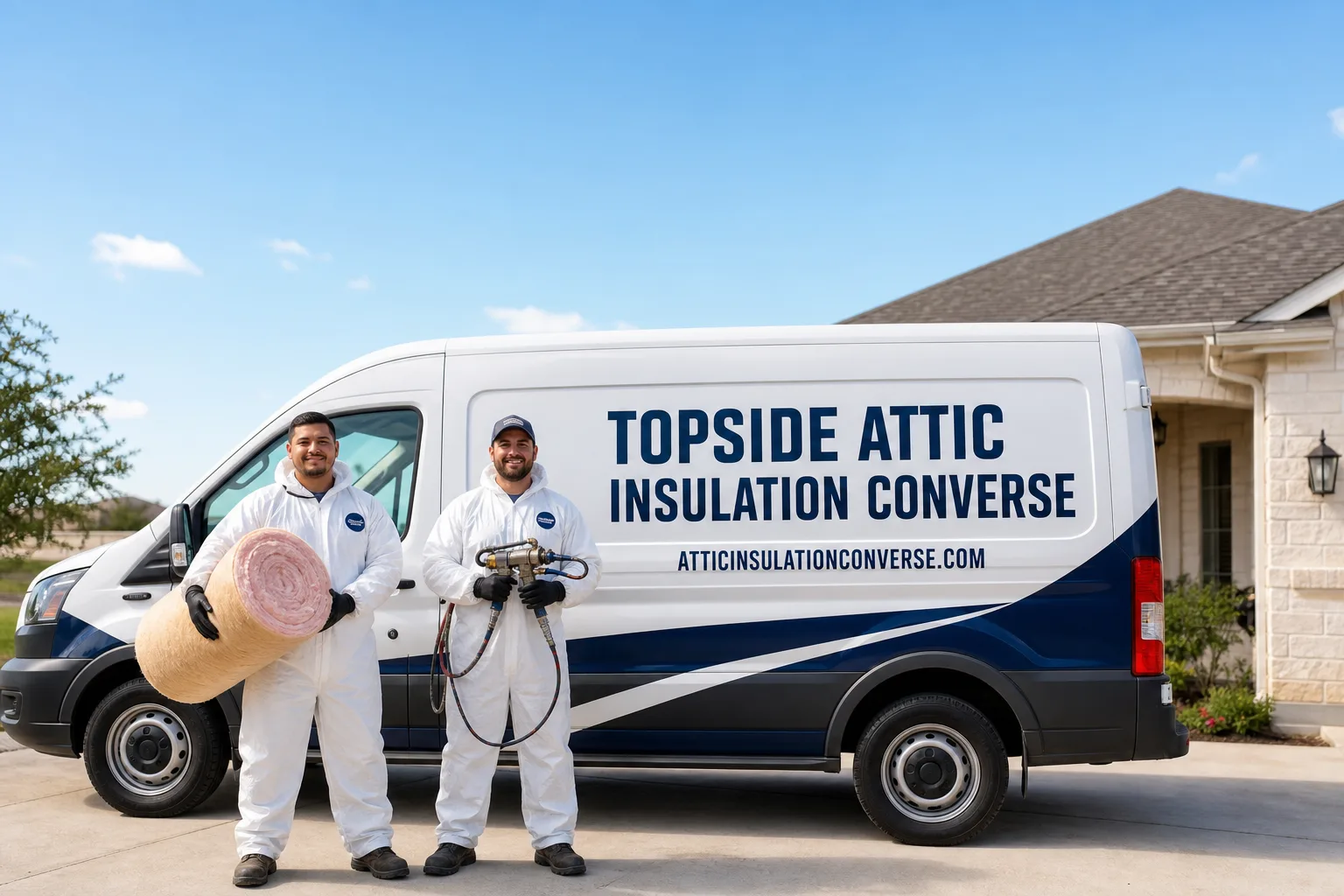
How Much Does Attic Insulation Cost in Converse?
Our Attic Insulation services in Converse, TX typically run between $1,400 and $3,800 for a standard single-story home, with most jobs landing around $1,900 to $2,400 once air sealing is included. The final number depends on your attic’s square footage, the insulation type you choose, how much existing material needs to come out first, and whether the attic floor has been properly air-sealed before any new insulation goes in.
If someone quotes you a number without walking your attic first, treat that number as a rough guess. Attic geometry in Converse varies more than you’d expect – low-slope rooflines in older sections near FM 1518, deep attics in the newer subdivisions off Kitty Hawk Road, and everything in between. A written price that comes with a written scope is the only kind worth comparing.
Attic Insulation Cost Breakdown (2026)
Most homeowners in Converse are choosing between blown-in fiberglass, blown-in cellulose, or spray foam – each with a different cost profile and a different set of trade-offs for South Texas heat. Here is what the Converse market looks like in 2026:
| Service / Material | Typical Cost Range (Converse, TX) | Notes |
|---|---|---|
| Blown-in fiberglass (attic floor, 1,000 sq ft) | $900 – $1,400 | R-38 to R-49 achievable; fast install; Owens Corning, Knauf, Johns Manville material options |
| Blown-in fiberglass (attic floor, 1,500 sq ft) | $1,200 – $1,900 | Most common attic size range in Converse subdivisions built after 2000 |
| Blown-in cellulose (attic floor, 1,000 sq ft) | $850 – $1,350 | GreenFiber material; slightly denser pack; good noise attenuation |
| Blown-in cellulose (attic floor, 1,500 sq ft) | $1,150 – $1,800 | Recycled content; performs well in Converse’s humidity swings |
| Spray foam (open-cell, roof deck application) | $2,200 – $4,500 | Icynene or Demilec; converts attic to conditioned space; highest upfront cost, lowest long-term air loss |
| Spray foam (closed-cell, partial application) | $1,800 – $3,800 | Used at rim joists, penetrations, and problem areas rather than full coverage |
| Attic air sealing (top plates, can lights, penetrations) | $350 – $750 | Done before any insulation is added – not an optional upsell |
| Old insulation removal (per 1,000 sq ft) | $500 – $950 | Required when existing material is contaminated, compressed below R-13, or contains rodent debris |
| Radiant barrier (foil, stapled to rafters) | $600 – $1,100 for 1,500 sq ft attic | Reduces radiant heat gain through roof deck; Converse summer attic temps regularly exceed 140°F |
| Full attic upgrade (air seal + blown-in + radiant barrier) | $2,100 – $4,200 | Most complete treatment for a Converse home; the combination that produces the largest measurable efficiency gain |
What Pushes a Job Toward the Higher End
Several conditions specific to Converse homes reliably move a project toward the top of those ranges. Homes built in the 1980s and 1990s near the Loop 1604 corridor often have knob-and-tube-era recessed lighting retrofits – each uninsulated can light is a direct hole in your thermal envelope, and every one needs to be capped and sealed before blown-in material goes anywhere near it. That takes time, and time costs money.
Attics with HVAC equipment and ductwork sitting in an unconditioned space add complexity too. In homes in the Converse area where the air handler sits in the attic, the labor cost to work around that equipment without disturbing connections runs higher than in homes with garage or closet-mounted units.
Old batt insulation that has settled, gotten wet from a slow leak, or been used as rodent nesting material has to come out before new material goes in. Removal adds $500 to $950 per 1,000 square feet – and skipping it, then blowing over the top of compromised material, is a mistake that produces neither the R-value on paper nor the comfort result you paid for.
What Keeps a Job Toward the Lower End
A clean, accessible attic with no prior damage, no HVAC equipment on the floor, adequate hatch access, and existing insulation that is still in acceptable condition keeps costs down. In newer sections of Converse built after 2010 – areas like the Forest Park and Meadows at Converse developments – attics are more uniform and faster to work in than the irregular geometries you find in older homes closer to Kitty Hawk Road. If you are adding insulation to a relatively new home that simply needs a top-up from builder-grade R-19 to R-49, that is a shorter scope at a lower cost.
What Affects Attic Insulation Pricing in Converse
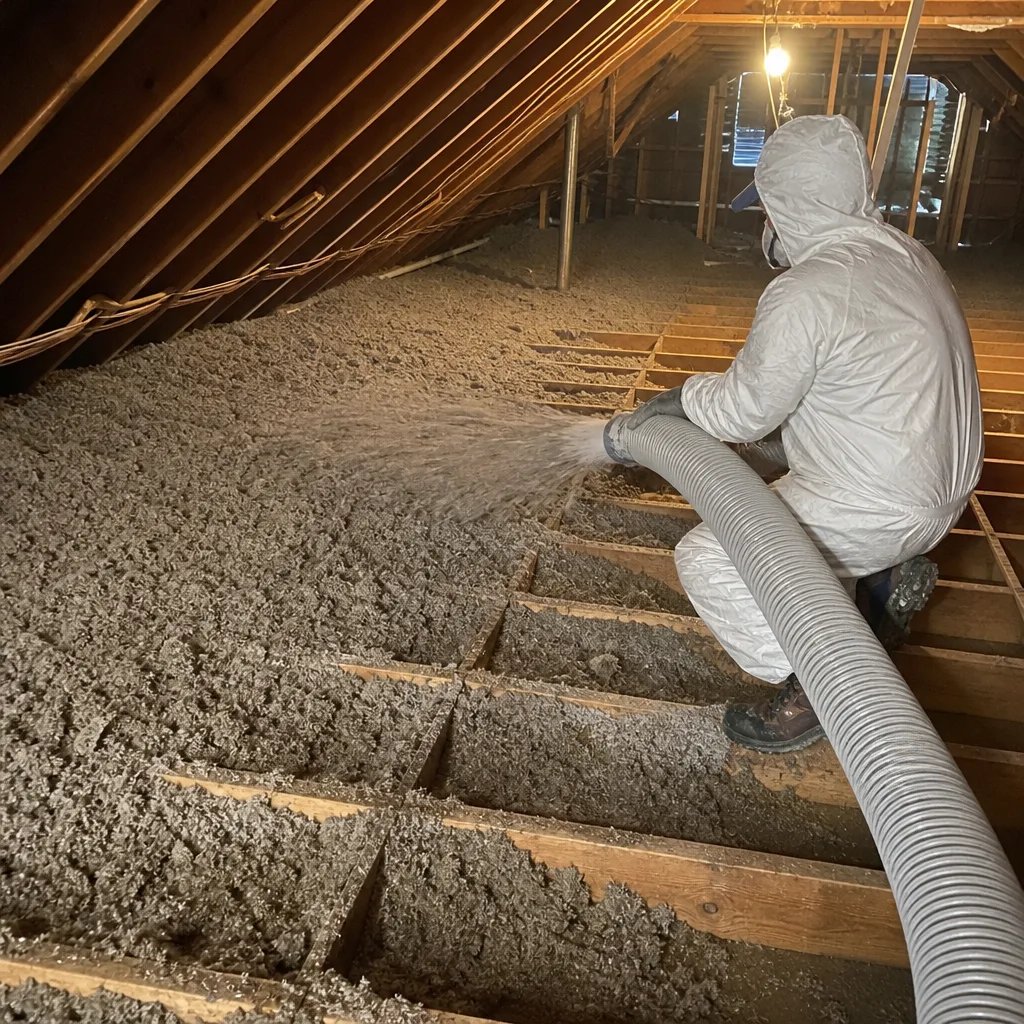
- Attic square footage and geometry. A 1,200-square-foot attic with clear, open joists costs less to insulate than a 1,200-square-foot attic with multiple valleys, knee walls, and HVAC equipment sitting on the floor. Converse has both types. The only way to price either accurately is to walk the space first.
- Insulation type and R-value target. The International Energy Conservation Code requires R-49 for new construction attics in Texas’s climate zone 2 (which covers Converse). Getting from builder-grade R-19 to code-minimum R-49 requires significantly more material than topping up a home that already has R-30. Each insulation type – blown fiberglass, cellulose, spray foam – has a different cost-per-R-value ratio.
- Air sealing scope. This is where the most meaningful variation lives. An attic floor with dozens of recessed lights, unsealed top plates, and open chases around plumbing stacks requires several hours of sealing work before insulation can be added. Skipping that work and just blowing in fiberglass is cheaper on day one and significantly more expensive over the life of the home – you are insulating a leaking bucket. At Envelope Insulation Co., air sealing of top plates, can lights, and penetrations is completed before any insulation is added, without exception.
- Existing insulation condition and removal need. Compressed, contaminated, or water-damaged insulation has to come out. Batt insulation that has been nesting material for rodents is a health concern and a performance problem. Removal adds cost but is not optional when the existing material is compromised.
- Converse’s climate conditions and what they do to attics. Bexar County and the surrounding Converse area see sustained summer heat that pushes attic temperatures above 140 degrees Fahrenheit on July afternoons. That thermal load is severe enough that the combination of air sealing, blown-in insulation, and a radiant barrier is not overselling – it is the appropriate response to the actual climate. A radiant barrier alone on a leaking attic floor does less than a sealed attic floor with adequate depth, so the order of operations matters as much as the materials chosen.
- Access and attic conditions. A pull-down stair with a 24-by-54-inch opening makes installation faster than a 22-by-22-inch hatch that requires every piece of equipment to be broken down and reassembled inside. Low clearance areas, irregular framing from additions, and stored material that needs to be moved all add labor time and move a job toward the higher end of the range.
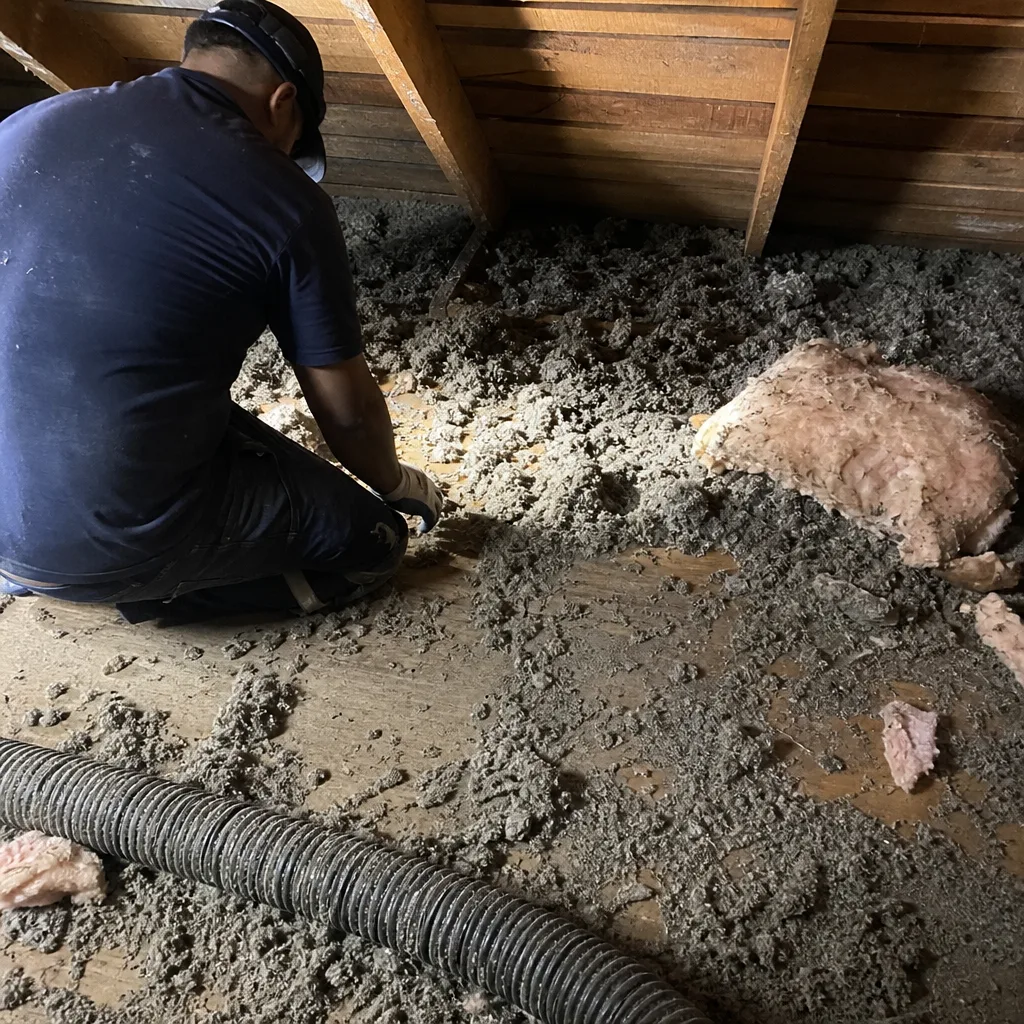 Before
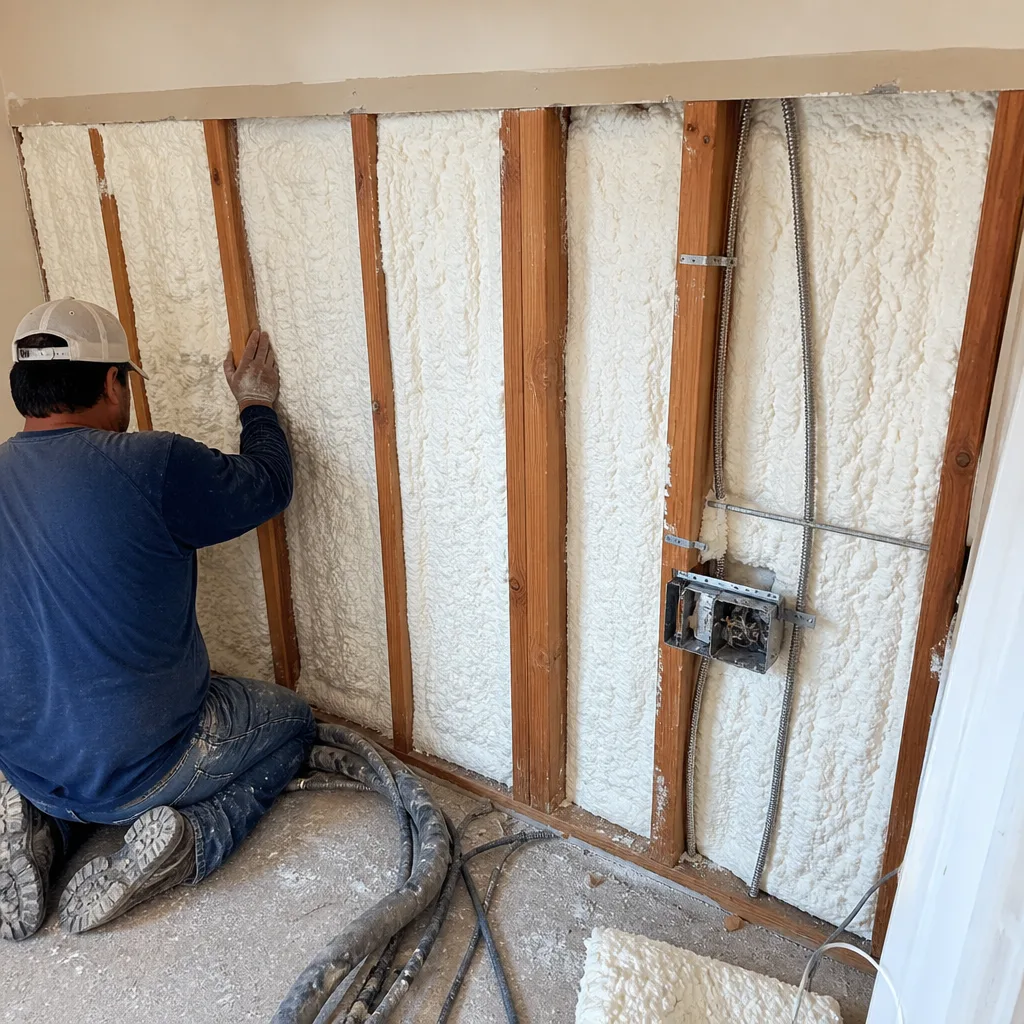 After
AfterBlown-In vs. Spray Foam: Which Is Right for a Converse Home?
This is the question we get most often when homeowners are pricing Attic Insulation Near Me in Converse, TX for the first time. The short answer: it depends on whether you want to insulate at the attic floor or at the roof deck, and what your HVAC situation looks like.
Blown-In Fiberglass or Cellulose at the Attic Floor
This is the standard treatment for most Converse homes – seal the attic floor thoroughly, then blow in material to R-49. Blown-in fiberglass from Owens Corning or Knauf and blown-in cellulose from GreenFiber are both proven in South Texas’s heat. Fiberglass holds up better in high-humidity conditions and does not settle as much over time. Cellulose is denser, slightly more effective at blocking air movement through the insulation layer itself, and carries more recycled content if that matters to you.
Either way, the attic itself stays unconditioned – hot in summer, but your living space below is separated from that heat by a properly sealed and insulated floor. This approach works well when your ductwork is in the conditioned space (inside the house) rather than sitting in the attic.
Spray Foam at the Roof Deck
If your HVAC equipment and ductwork live in the attic, spray foam applied to the underside of the roof deck converts the attic into a conditioned space. The attic temperature drops from 140 degrees to something close to your indoor temperature, which dramatically reduces the load on the ductwork running through it. Icynene and Demilec open-cell spray foam are the materials we use for full roof-deck applications. This is a higher upfront investment ($2,200 to $4,500 depending on attic size) but it addresses duct losses that blown-in floor insulation does not touch.
Closed-cell spray foam is used selectively – rim joists, band joists, and specific penetration areas where its higher R-value per inch and vapor-barrier properties justify the cost. Full closed-cell applications at roof decks are rare in Converse because open-cell performs adequately for the application and costs significantly less.
Our Attic Insulation in Converse service page walks through each option in more detail and explains how we document the result of whichever treatment we install.
The Air Sealing Step Most Contractors Skip
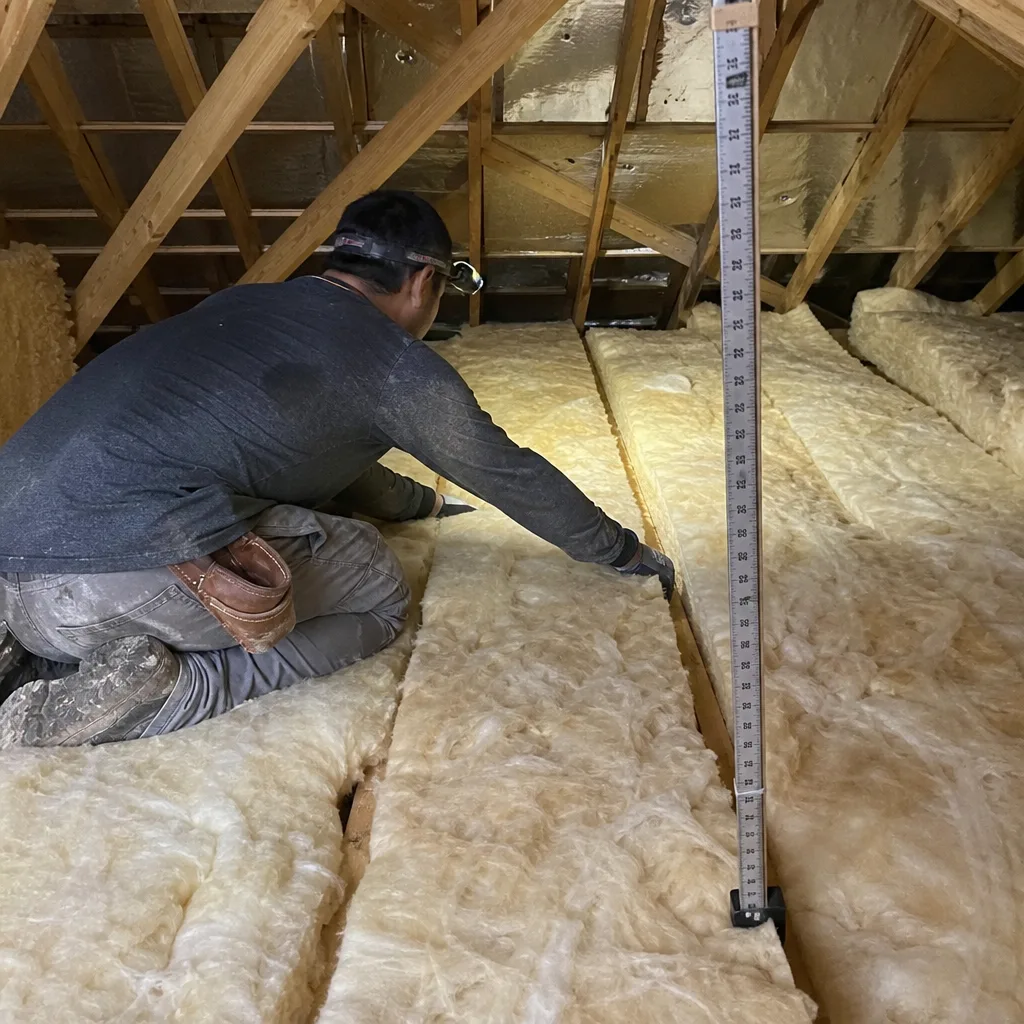
This section matters more than most homeowners expect, so it is worth being direct about it.
In Converse homes built before 2005, the attic floor typically has dozens of air leaks: unsealed top plates where interior walls meet the attic floor, open cavities around plumbing stacks, recessed light cans that are open directly to the living space below, and gaps around electrical penetrations. A blower-door test – a pressurization measurement that shows, in a single figure, how much conditioned air the building envelope is losing – will quantify exactly how bad the situation is.
We have run blower-door readings on Converse homes near the Green Valley Farms area that came in above 5,000 CFM50 before sealing, and below 2,800 CFM50 after sealing the attic floor alone, without touching a single window or door. That is a measurable reduction in conditioned air loss that shows up on an electric bill within the first full billing cycle after work is complete.
The problem is that blown-in insulation over an unsealed attic floor does not stop that air movement – it slows it down slightly while the air finds its path around the insulation to the leakage points. The R-value on paper does not represent the thermal performance in practice when air is flowing through the assembly.
Under the Haven Standard that governs how Envelope Insulation Co. operates, we will not blow insulation over an unsealed attic floor. Air sealing of top plates, can lights, and penetrations is completed before any insulation is added. Before-and-after blower-door numbers are published on every applicable job so the homeowner has a documented record of the air-sealing result, not just a sales claim about it.
Does Attic Insulation Qualify for a Tax Credit in 2026?
Yes – as of 2026, the Energy Efficient Home Improvement Credit (Section 25C of the federal tax code) covers insulation materials at 30% of the installed cost, up to $1,200 per year. Attic insulation and air sealing materials qualify when they meet the IECC standard for your climate zone.
A few things worth knowing: the credit applies to materials costs, not necessarily the full labor cost, depending on how your contractor invoices the work. The tax credit does not reduce the amount you pay to the contractor – it reduces your federal tax liability when you file. Keep the written scope, the invoice, and any manufacturer documentation; you will need them when you file.
Texas does not have a state income tax, so there is no state-level insulation credit to stack on top of the federal one. However, CPS Energy (which serves portions of Converse through San Antonio’s utility territory) has offered rebate programs for insulation upgrades in recent years. Check directly with your utility provider for current rebate availability, since those programs change annually.
How to Save on Attic Insulation in Converse
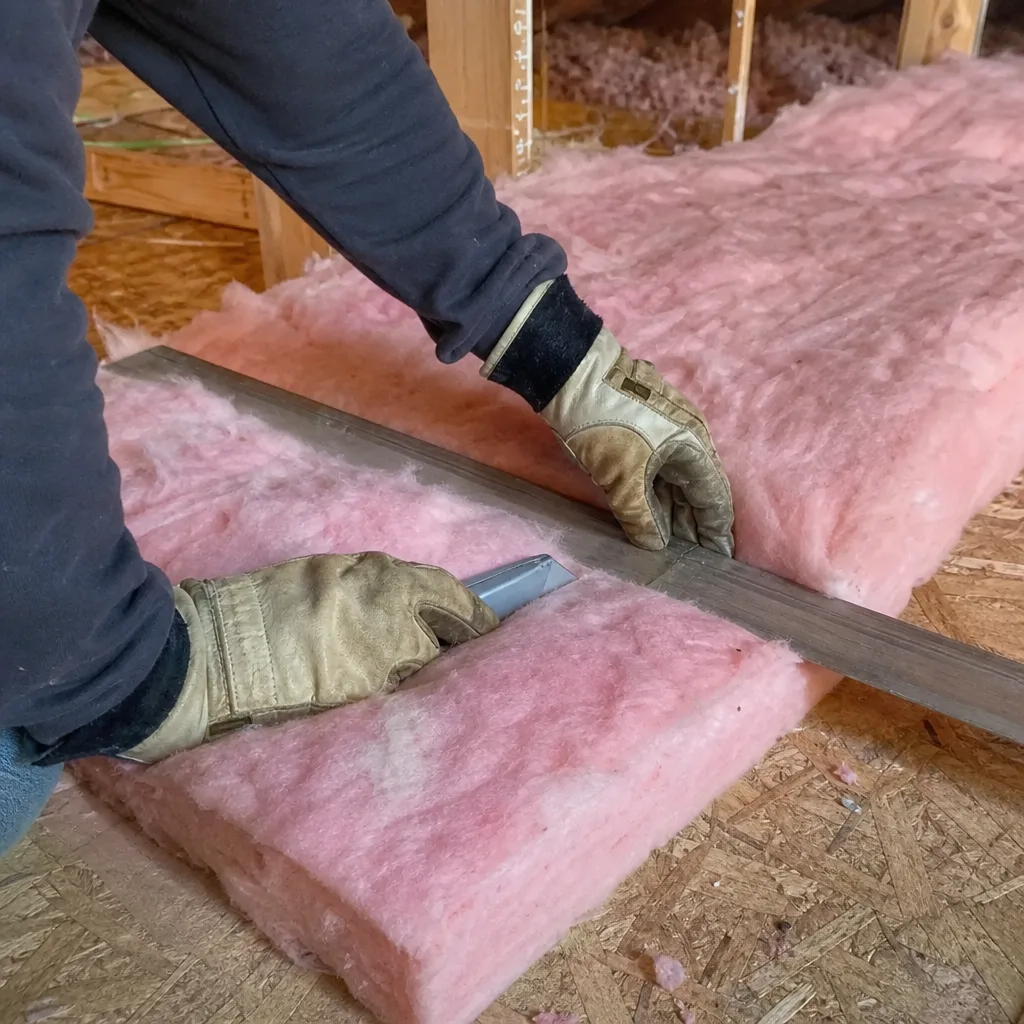
The most reliable way to save money on an attic insulation project is to get a price that is accurate the first time. A quote that does not account for removal, air sealing, or access difficulty is going to come in low and then climb. That is more expensive than a complete, written scope at the start.
- Get a written price that covers the full scope. Under Haven Standard Clause 1 at Envelope Insulation Co., you receive a flat price, a written scope, and a written warranty before anyone starts work. That means no surprises at the end of the job. Compare bids that include the same scope – materials, air sealing, any removal, and cleanup – not just the insulation itself.
- Ask about the federal tax credit before you commit. If your project qualifies for the 25C credit, 30% of the materials cost comes back as a tax reduction. On a $2,000 materials portion of a job, that is $600 returned at tax time. Ask your contractor to separate materials from labor on the invoice.
- Check your utility for current rebates. CPS Energy and Bexar County-area utilities have offered insulation rebates in prior years. Even a $200 rebate on a $1,800 job is worth fifteen minutes of research.
- Combine services when you are already in the attic. If you are adding insulation, have the air sealing and radiant barrier done at the same time. Mobilizing a crew to your home is a fixed cost – adding scope during that same visit is always cheaper than scheduling two separate visits.
- Get a second opinion on any written estimate. Envelope Insulation Co. offers a free second opinion on any written competing estimate – we will read the scope with you and explain what it includes and what it does not. A written estimate that does not specify the R-value target, the air sealing approach, or the material brand is not a complete price.
If you want a number specific to your attic, call (830) 420-0953. Estimates are free and written – you will have a price in hand before any decision needs to be made.
Converse Neighborhoods We See Most Often
We work throughout Converse and the surrounding Bexar County area. A few notes on what we tend to find in different parts of the market:
Homes in the older sections near Converse Road and FM 78 – built primarily in the 1970s and 1980s – frequently have original fiberglass batts that have compressed over decades from foot traffic, settled into gaps, and in some cases been used as nesting material. These homes almost always need Attic Insulation Replacement rather than top-up, and the air sealing scope is typically larger because construction practices from that era did not treat the top plate as part of the air barrier.
Newer subdivisions along Kitty Hawk Road, Converse Lane, and the Forest Creek area built between 2000 and 2015 typically have blown-in fiberglass at builder-grade depth – R-19 to R-22 – which is below the current R-49 target for this climate zone. These homes are good candidates for a straightforward Attic Insulation Top-Up combined with can-light air sealing, which is faster and less expensive than full removal.
Homes in the Green Valley Farms and Heritage subdivisions, built mostly after 2010, sometimes have adequate insulation depth but inadequate air sealing – the insulation was blown in correctly but the attic floor was never sealed underneath it. A blower-door test identifies this situation clearly; it reads as higher-than-expected air leakage for a home with apparently adequate insulation depth.
What the Job Looks Like From Start to Finish
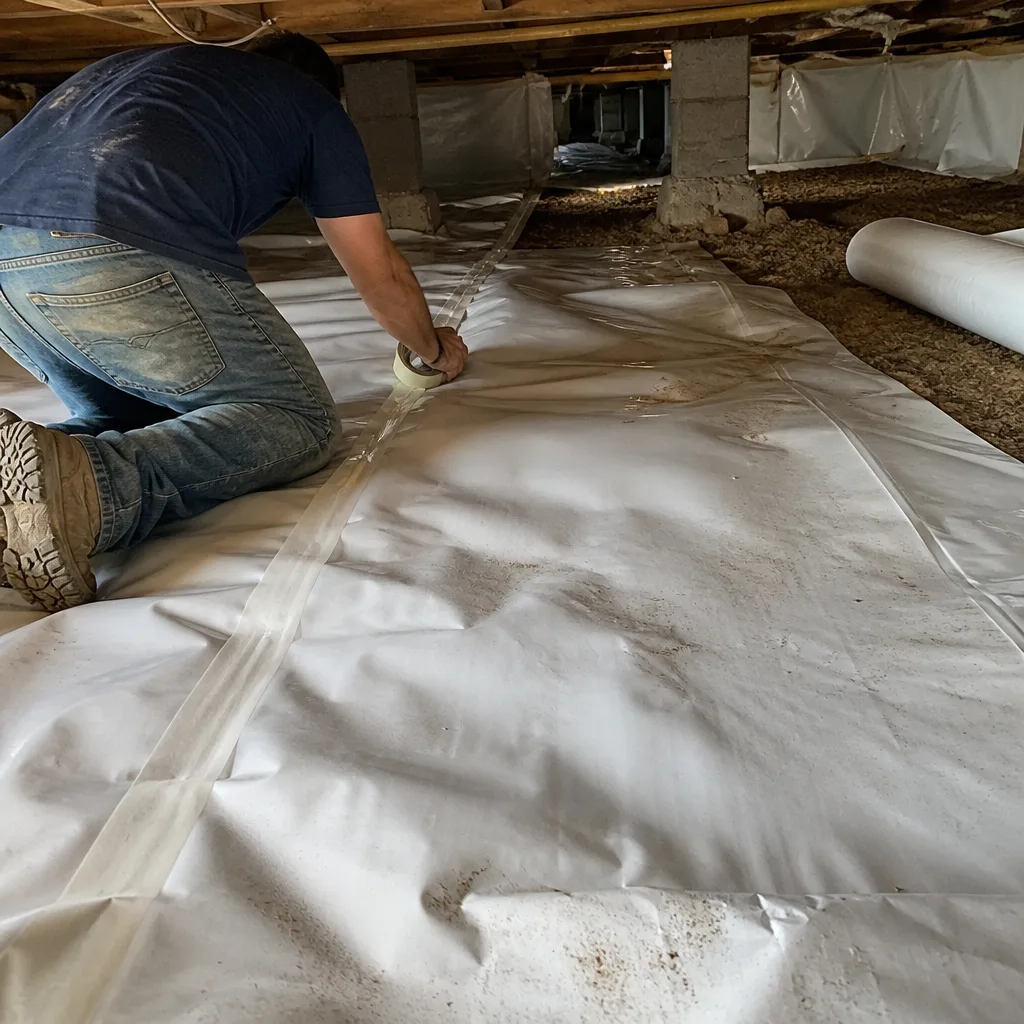
From our home base serving the greater San Antonio metro, a typical Converse attic insulation job follows this sequence:
- A technician walks the attic, measures the space, checks existing insulation depth and condition, notes penetrations and air-sealing needs, and photographs the starting condition. You receive a written price – flat rate, full scope, written warranty – before the crew schedules.
- On installation day, the technician performs air sealing first: top plates are sealed with foam or caulk, can lights are capped with approved covers, plumbing and electrical penetrations are sealed. This step is not optional and is not completed after the insulation goes in.
- Blown-in material is installed to the specified depth – confirmed with depth markers visible in the photo documentation.
- If a radiant barrier is part of the scope, foil is stapled to the underside of the rafters before the crew leaves.
- On applicable jobs, a blower-door test is run after completion and the before-and-after reading is documented in the job record. You receive that number. It shows what changed, in CFM50, from before the crew arrived to after they left.
- The Documented Photo Record is delivered with the completed job. The 365-Day Done Right Promise is active from the day the crew leaves.
FAQs: Attic Insulation Cost in Converse, TX
How much does attic insulation cost in Converse, TX in 2026?
Most attic insulation projects in Converse run between $1,400 and $3,800, with the majority of single-story homes landing in the $1,900 to $2,400 range when air sealing is included. Spray foam applications at the roof deck run higher, from $2,200 to $4,500 depending on attic size. The only way to get an accurate number is a written estimate based on a physical walk of your attic – call (830) 420-0953 for a free estimate with a written price before any work starts.
Is it cheaper to add insulation on top of existing insulation or remove and replace?
Adding on top of existing insulation is cheaper when the material underneath is dry, undamaged, and not compressed below roughly R-13. In that case, you are paying only for the top-up material and air sealing. Removal is necessary – and the correct choice – when existing insulation has been wet, compacted below usefulness, or contaminated with rodent material. Removal adds $500 to $950 per 1,000 square feet but blowing new insulation over compromised material produces neither the stated R-value nor the comfort improvement you are paying for. A technician who will not walk your attic before giving you a price cannot tell you which situation you have.
Does attic insulation in Converse qualify for a federal tax credit?
Yes. The Section 25C Energy Efficient Home Improvement Credit covers 30% of qualifying insulation materials costs, up to $1,200 per tax year, through 2032. Attic insulation that meets the IECC standard for Texas’s climate zone qualifies. Keep the written scope and invoice – you will need documentation of the materials cost when you file. Check with your tax preparer on how to separate materials from labor costs on the invoice for maximum credit eligibility.
How long does attic insulation installation take in a typical Converse home?
A standard blown-in insulation job on a 1,200 to 1,500 square foot attic – including air sealing – typically takes four to seven hours from crew arrival to cleanup. Larger attics, removal jobs, or spray foam applications run longer. A job with significant air sealing scope (many recessed lights, open top plates, multiple chases) adds time to the air-sealing phase, which is completed before any insulation is added. You will have a written scope before the job starts that describes what work is included, so there are no surprises about what the crew is doing or how long it takes.
Can I just add insulation without doing air sealing?
You can, but the result will underperform relative to what you paid for. Air movement through an unsealed attic floor bypasses insulation – conditioned air finds the path of least resistance through top-plate gaps, can-light openings, and plumbing penetrations, and the R-value of the insulation does not stop that. A blower-door test on a home with R-30 blown over an unsealed floor typically shows more air leakage than a home with R-19 over a sealed floor. Envelope Insulation Co. does not add insulation over an unsealed attic floor; air sealing is completed first on every job. If you have a competing estimate that separates air sealing as an optional line item, bring it in – we offer a free second opinion on any written estimate and will explain what that choice means for long-term performance.
What R-value does my Converse, TX attic need?
The current IECC standard for Converse, which sits in Texas climate zone 2 (transitioning to zone 3 at the county line in some classifications), calls for R-49 at the attic floor for new construction and significant renovations. Most homes in Converse built before 2010 are sitting at R-19 to R-30, and homes built before 1990 often measure below R-13 once you account for settling and compression. Getting from R-19 to R-49 requires adding approximately 5 to 6 inches of blown-in fiberglass at the current product densities. A technician with a depth probe and a current product spec sheet can tell you exactly how many inches of material you need to hit R-49 starting from whatever you have now.
Written by Wes Okafor, Owner at Envelope Insulation Co. (operating as Topside Attic Insulation Converse), serving Converse and the greater San Antonio metro since 2016 under The Haven Standard. Pricing reflects the Converse, TX market as of 2026. Topside Attic Insulation Converse offers free estimates with a written price before any work starts – call (830) 420-0953.
What Our Customers Say
"They photographed rodent damage in the old insulation that we had no idea about, and priced the exclusion work separately so we could decide."
- Harriet N."Turned up on time, protected the hallway, and the written scope matched what was actually done."
- Bruno S."They air-sealed the attic floor before insulating and showed me the blower-door number before and after. The upstairs is finally the same temperature as downstairs."
- Marisol D.